Sunday, September 13, 2020

Trump vs. Biden: My Vote


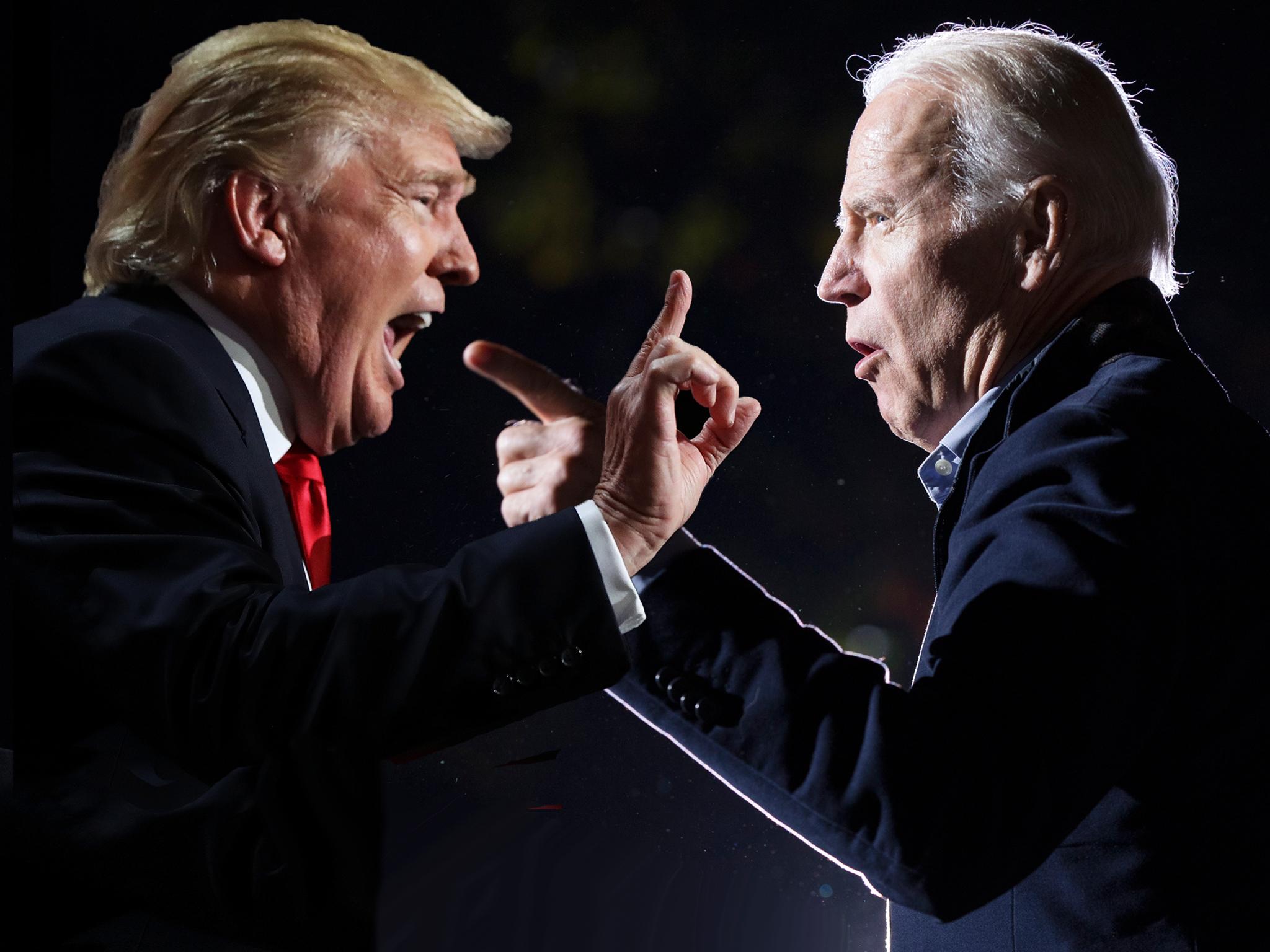
It's almost time for us to cast our votes. Trump vs. Biden? Who's it going to be?

Before I begin, please keep in mind that I am not seeking to sway votes, but rather I am sharing the reasons behind my ultimate decision, which I think you will find interesting. I do not seek to say: "If you disagree with me then you're a murderer and our civilization will die if you seriously vote for that other guy," as this is exactly what I hear from a lot of my social media friends from BOTH sides of the aisle! I can only conclude that if this were true, I'm screwed either way I vote.

I fully understand why Trumpers want Trump, and why Bideners (and anti-Trumpers) want Biden, and I fully respect your reasons. There is good in both candidates, and there is also bad. I do have strong opinions, a lot of which are molded by my specific set of experiences. And I also understand a lot of independents are in the middle trying to decide which way to go.

So, here goes nothing ... starting with a review of our incumbent candidate. Along the way I'll link to other political posts I've made in the past so you can more fully understand my position in life, and also give you much more information than you'd probably care to know.


Trump: The Good
If you look closely at Trump, you'll see what I see: two totally different individuals. 

One is the more visual: the Tweeter in Chief, the Name Caller, the Alternative Fact-er, the Fake News Pointer, the Hothead, the Downplayer, and so on.

But there is another Trump who comes out rarely, whom I've seen several times ... the Trump that most of his base see. He's much more sincere, more compassionate -- the Trump that can enter a room, walk up to a perfect stranger, put his arms around him, and make him feel that everything is right in the world. Yeah ... I know my liberal friends are thinking: What are you smoking, Mel?

Just bear with me. I do think that he believes he's sincere. He thinks he's doing all the right things. There are areas where he excels, such as making deals -- of which he's already brokered several that benefit the US than before. He has also been able to broker some surprising peace accords between antagonistic parties.

It may be worth looking back to early 2016 when I described my Like Trump experiment. I was able to come to a better understanding of what his base see in him. And I still see some of those same good traits in him today. If anything, he has been consistent, and I don't think much of his base has left him over the past four years.

In early January 2017, I thought I saw more of the humble Trump in his preparation of being one of the most powerful people in the world. So, I actually had some hope that Trump would realize the seriousness of his new position and be more humble.

As a fiscally conservative type of guy, I've been very supportive of most of his economic policies. I love the corporate tax reduction -- a major step in the right direction. I also love that my middle class self has benefited from a $1000 credit the first year under the new tax cut. That is ... I did my taxes old way and new way to compare, and Trump's tax cuts gave me back $1000 more. In fact, the vast majority of people received more taxes back, despite that to this day some liberals still tell their base that they've paid more in taxes due to a confusion between weekly tax payments and the year-end true-up.

Though, I'm not too happy about the state deduction cap and what I like to call the "large family" tax. Also, I think it did cut a little too much on the rich side ... they could definitely afford to pay more in taxes. And this cut was not met with any compensating tax increases or reduction in government expenses, which helped to increase the annual deficit each year -- though we're not quite at Obama levels yet.

But wait -- I need to stick to good stuff this section. I'm also happy with the two conservative judicial picks under Trump. I prefer a balanced bench, and I think we have a good set of judges with 4 conservatives, 4 liberals, and one swing vote (slightly conservative leaning).

I do appreciate some of the recent rulings that reinforce the freedom of religion -- though I have to be a little careful here, as I'm not exactly happy with all the rulings ... I mainly like the idea of people not being forced to do what they don't want to do, as long as that doesn't infringe on the rights of others.

I do think Trump's economic policies have indeed helped jobs to come back to the US, though maybe not as much as he might have hoped.

But then again, I would think just about any conservative president would accomplish these same exact tasks. I would much rather have someone like Romney in his place right now.


Trump: The Ugly
Next comes all the ugly bits about Trump, and he has a lot. 

I already mentioned Twitter in Chief. Never before has any president used social media to speak off script. Toward the beginning of his presidency when I was happy with most of what he was achieving, I mentioned several times: if Trump were to simply stop tweeting, he could be a decent president.

His tweets are usually on the idiotic side, usually divisive in nature, and sometimes indecipherable. Sometimes it even sounds like a kid accidentally logged into Trump's account. And there have even been several times that his tweets reveal too much information that really shouldn't be available to the general public. In a couple of instances, the information he had revealed even put agents' lives in danger. (Though one of those instances wasn't a tweet, but rather during a meeting with other foreign dignitaries.)

Trump often talks big about himself, even if he has to resort to stretching the truth, or as Kellyanne Conway called it: alternative facts.

After narrowly winning the needed electoral votes and having lost the popular vote, Trump claimed that he had won in a landslide, and most of his base believe that even today. However, by any mathematical analysis, it's very easy to see that Trump's win was narrow. I submitted such an analysis back in 2017.

If anything, this picture I prepared should explain all you need to know to see that his win was not a landslide.


Trump also stated that he had more people attend his inauguration than did Obama, and he said the following picture was fake:


In this blog post, I show an analysis from an independent photograph that proves that this picture was not fake. (Though it really is possible that more people watched Trump's inauguration on TV than they did for Obama. After all, who would want to miss that?)

One of the reason I didn't like Obama was because he was such a divisive leader. Right from the start he said to his opponents: I won, you didn't, and you will listen to me. And that pretty much began the gridlock that would ensue. He also attacked Rush Limbaugh and Fox News on several occasions, saying they were not real news.

But whatever Obama did in his eight years in office, Trump outdid it all in just a couple of months. Starting from his inaugural speech when he made it clear that he was not going to be that humble president I was hoping for, Trump has been alienating his opponents this whole time. Instead of attacking Fox News, Trump instead attacks practically everyone else, calling them all FAKE NEWS. Always in all-caps. Very non-productive and borderline unconstitutional -- though I should point out here and now that saying it is different than actually taking action -- on this issue Trump has made sure to stay on the constitutional side of things in a letter-of-the-law sense.

These are all symptoms of the same issue: Trump just isn't a diplomat. He doesn't exhibit the minimum amount of decorum that all presidents in my lifetime had exhibited -- the way that you show respect to everyone, not call them childish nicknames, not mock people with childish gestures, and all-around listening to people.

Though, a part of me has always admired his "my way" approach to things. His unconventional ways may have helped him get away with certain accomplishments -- similar to Nixon in China. But other than those achievements, I think his unique way of handling things in the states has been much more negative than positive.

Also, I think he has done a terrible job responding to the BLM-related riots currently going on. At first, he did mention that what had happened to George Floyd was "sad and tragic," but these days he hardly brings it up anymore. Rather he talks about how he needs to use "law and order" to quell the riots, entirely ignoring the underlying issues causing the riots to happen in the first place.

This is the Trump most everyone is used to seeing. Sometimes he embarrasses me in front of the world. Sometimes I enjoy laughing at our Comedian in Chief.

And I've heard several people say, especially now that we're getting ready to vote again, that: "You're voting for a leader, not a best-friend -- he doesn't have to be perfect and refined like you want him to be. You need to look at his policies, which will last longer than Trump himself. If you like his policies, and not his opponent's then it should be clear who you need to vote for."

To this, my first thought is ... but I am choosing a leader. And BTW, most of my friends are imperfect, and I love them in their imperfections, and I wouldn't change them.

As for choosing leaders, I strongly believe in the instruction my church often provides: "[We] are to seek out and then uphold leaders who will act with integrity and are wise, good, and honest." I do not think Trump fits these requirements. (More about this coming in another blog post next week in The Mormon Mel.)

Then again, I must be honest. If everything up to now were the only things wrong with Trump, I would most likely vote for him come November. Because he would be the "evil that I know" and would be happy to have him carry out four more years if only to get a few more conservative fiscal policies passed to help the economy more.

But everything I've written up to now is not the whole story of Trump. What comes next are the real reasons I will NOT be voting for Trump. These are actual policies that I just cannot in good consciousness support going forward.


Trump: The Bad
As far as immigration is concerned, I've always been of the mindset: "Help them become legal, make them pay taxes." If someone really wants to be here, then let them. After all, that's what makes America so great -- so many cultures merging together so we can benefit from the best of all worlds. None of us wouldn't be here if we didn't have an ancestor who left their motherland to come here.

I've always thought that Democrats were historically the ones against immigration ... gotta protect our jobs. And maybe the 9/11 attacks curtailed our desire to accept immigrants, but one thing's for sure ... Trump helped to introduce and lock in xenophobia into the Republican Party -- possibly a holdover from when Trump used to be Democrat -- maybe?

Whatever the case, at the end of 2015, Trump made it clear that he hated Mexicans and Muslims. At the time I didn't think he had a chance to win the Republican nomination because of his blatant racism and/or xenophobia toward those two groups. In December 2015 when Trump proposed his Muslim ban, it shocked practically everyone. Even my church made a statement. For a few days the world was united against Trump and his racist ideas. Every other Republican candidate condemned his thoughts. Why would Trump suggest anything so clearly against the 1st Amendment concerning religious freedoms?

And then they didn't. As Trump quickly increased in popularity, the most prominent Republican candidates became more afraid to challenge Trump, fearing that it would look bad and cause themselves to lose votes in the quickly approaching primaries. Rather, they started speaking up in SUPPORT of said Muslim ban. Only Jeb Bush and Marco Rubio stood against Trump. I really wanted Jeb Bush to be the Republican candidate.

So, in January 2016, I made a decision for myself. Seeing that if the Republican Party were to support such an unconstitutional idea, then maybe it wasn't the party for me. If they weren't going to condemn Trump and stop him from becoming the nominee, then I didn't want any part of it. So, I officially switched my party affiliation to Unaffiliated.

Now Trump is the President, and he's had his chance to enact policies that has made it harder to come into the country legally, and has caused a lot of pain to many people ... all in the name of border security. He has started building an expensive wall that is more of a symbol than it is an effective way of keeping people out. And he has chosen to vilify one of the strangest groups to choose from ... our neighbors, who really are the least we should be worried about. What exactly is Trump protecting us from? Taco trucks at every street corner?

Immediately after going into office, Trump got to work on the first version of his Muslim ban. Here are my thoughts on that first ban. He got the list of predominantly Muslim nations from Obama's time in office, but he included in the language a religious test -- where prioritization would be given to those belonging to a "minority religion." And what religion is minority in those areas? Christianity, for one.

Judges jumped on that clearly unconstitutional clause. I believe Trump's lawyers argued that the Constitution doesn't apply to people outside of our country. My response: if it doesn't, then what good is our Constitution?

Trump put an end to it by instituting Version #2, which basically removed that paragraph. So, the letter of the law was stricken down, but the spirit of the law was maintained.

There's more to the story, of which I haven't been paying attention, but this ACLU website gives more details in further developments which have been happening quietly in the background.

By far, this bothered me because it seemed to target the Syrian refugees who were fleeing death and persecutions. The great country of the USA was going to refuse help to these people in need, under the guise of possibly allowing terrorists unknowingly inside our borders. (As if we don't do any kind of vetting.)

And then came the crackdown on the Mexicans and Central Americans trying to come through our southern borders. Trying to keep the story short, Trump had instituted an asylum ban when it was getting bad. And most people here in the states seem to have no idea how devastating this was to many families fleeing death and persecutions from antagonistic gangs. There are many reports of illegally-crossing asylum seekers who were deported back to Mexico only to be immediately picked up by awaiting gang members, tortured, and killed.

In addition, Trump famously had families separated at the borders, supposedly due to a law that came into effect during Obama's presidency. The idea is this: if you cross our borders illegally, then you are a criminal. Thus you need to be thrown into jail. But we have this law that says we can't throw children into jail, so we have no choice but to separate you.

Some say that Obama also separated children, but by count, Trump's administration did it far more than Obama's did. The "zero-tolerance" stance was what really led to the conflict with the Obama-era law, which caused at least 2,800 children to be separated under Trump. There was no "zero-tolerance" stance under Obama, so it happened far less frequently -- perhaps under 100, and only in cases where the children seemed to be in danger.

These actions against Syria, Mexico, and Central America violate the Geneva Convention Relating to the Status of Refugees, which states that countries should not do the following:
  • impose penalties on refugees who entered illegally in search of asylum if they present themselves without delay (Article 31), which is commonly interpreted to mean that their unlawful entry and presence ought not to be prosecuted at all;
  • take exceptional measures against a refugee solely on account of his or her nationality (Article 8);
  • forcibly return or "refoul" refugees to the country they have fled from (Article 33). It is widely accepted that the prohibition of forcible return is part of customary international law.
I totally get wanting to increase enforcement at our borders, and to have even better vetting, but I can't think of any angle that makes it okay to refuse refugees, to send them back into dangerous territory and not care when they are killed in the process.

I also get the desire to have people enter the gates legally. I share in that desire. I have many legal immigrant friends who did things the right way. 

But what a lot of people don't seem to understand is that Trump has intentionally made it harder to enter at the gate legally. In 2017, the limit for incoming refugees had been set by the Obama administration at 110,000. In 2018, Trump had this reduced to 45,000. And then 30,000 for 2019. And 18,000 for 2020.

At the Mexican border, those trying to enter legally have reported receiving the run-around, and many of them in desperation decided to chance crossing illegally.

As you may remember in late 2018 a caravan of migrants tried to cross illegally at the same time. In response, Trump sent an army of 5,000 troops to join 2,000 National Guard to secure the borders. It appears that the US (behind the scenes) was making an attempt to process asylum requests, but the slowness caused several of the migrants to storm the border, resulting in a big commotion (though I think no one died).

At the time it may have been prudent to send troops to increase security, but I've pointed out several times that Trump's usual answer to these type of things is to send troops instead of social workers. Had he done the latter and had workers be able to process claims much more quickly, and make the good ones legal, then it wouldn't have come down to needing troops.

Trump's priorities in regards to Mexico are clear, and I do not agree with these policies.

Then enters Ken Cuccinelli, who may be one of the most racist people I've ever seen to be appointed as the Director of the US Citizenship and Immigration Services. Shortly after being appointed in June 2019, he instituted a new means-testing requirement for those with green cards. If a family is determined not to be sufficiently self-supporting, then they could lose their green card. In other words, it is now harder for legal immigrants to remain legal, and that bothers me.

In an interview, Cuccinelli was asked about the new regulation: "What do you think about what it says at the bottom of the Statue of Liberty?" Cuccinelli responded: "Give me your tired and your poor who can stand on their own two feet and who will not become a public charge."

Cuccinelli was then subsequently named as some kind of Deputy of Homeland Security where he had influence in deploying armies in Portland against BLM protests, and also the failed recent decision to require international students to attend in-class instruction in order to remain in the country (during the coronavirus pandemic).

All of these immigration policies alone are enough to stop me from voting for Trump, but sadly that isn't all.

I just mentioned the troops in Portland, but backing up a little bit, the real shoe fell when Trump gave his Law and Order speech on 6/1/2020. He said:
If a city or state refuses to take the actions that are necessary to defend the life and property of their residents, then I will deploy the United States military and quickly solve the problem for them.
He also invoked the second amendment, which at first seemed strange, as it really has nothing to do with the riots and the George Floyd protests. (How are the right to bear arms in jeopardy?) He said:
I am mobilizing all available federal resources — civilian and military — to stop the rioting and looting, to end the destruction and arson, and to protect the rights of law-abiding Americans, including your Second Amendment rights.
But the effect was immediate. The images of storm troops on domestic soil sent an instant shiver down my spine. And sure enough, we got to see some of that play out -- first as self-proclaimed militia (some of which consisted of white supremacists) started patrolling the streets. And then the whole Portland thing of Cucinelli troops illegally carrying away people in vans. And also the unfortunate incident in Wisconsin when a teenager involved in a militia ended up killing two people. All of which could have been avoided if Trump had not invoked his usual troops-on-the-ground solutions when so many other more effective solutions exist.

If this all wasn't enough, we can add to this Trump's response to the coronavirus disaster. I've already written about that last week in this blog with much detail, so I won't repeat it all again. In a nutshell, with his record, I seriously would doubt his ability to protect us from another outbreak, such as Ebola -- from which Obama protected us in 2014 and surrounding years.

As part of this whole coronavirus pandemic and the mail-in voting movement, I should also mention briefly Trump's intentional sabotage (to which he has admitted) of the US Postal Service. And I should also mention his repeated instruction to his base to vote twice (once by mail and once in person) in order to ensure votes get counted. I see all of this as a clear attempt to sabotage the whole system in his favor for this coming November.

I'll end this section with something that may seem small to you, but I evidently find this one somewhat upsetting, and that is Trump's continual insistence of forcing people to stand for the National Anthem.

Don't get me wrong. I love the National Anthem. I always stand, and when appropriate, I'll sing loudly and proudly. Some of my favorite memories include the couple of times I got to sing the Anthem from the mike at sports events.

But this country was built on the idea of freedoms and non-coercion, so I find "you better stand or else" to be somewhat ironic and non-constitutional. You can read my full thoughts here. It's really subtle, but I present this as well as some of the other items above as evidence that Trump may be the most out of recent presidents to seriously jeopardize the Constitution.

I don't think that Trump is evil. I still don't think he's Hitler, and if elected, I don't believe he's going to send in his storm troops and ensure himself a third term. Rather, I think he's just incompetent and doesn't know how to handle all these items that I've listed above. I don't think he realizes he's being unconstitutional when he threatens people who don't stand for the flag. He's just pushing his heavily-held opinion that people should stand for the flag and the anthem. I don't think he knows how to handle the BLM protests and say the right things to diffuse the riots. He doesn't know how to handle pandemics, and would much rather ignore them and hope the virus magically goes away (still waiting for that to happen). And his xenophobic ideals are causing pain and death.

We've already seen what has happened under his watch, and in my opinion, his record speaks for itself. He's just the wrong man for the job, and he does not have my vote in 2020.


What About Biden?
To be honest, I was very happy that Biden was chosen as the Democratic nominee. I know in the past I've called him an idiot. I've even said he's one of the few people who looks like his own party mascot. So, past Mel is very surprised to discover that current Mel is actually considering voting for Biden.

Out of all the Democratic candidates, I found Biden to be the closest to what I believe. He was the most moderate of the bunch. In early 2020, it looked as if Bernie Sanders was going to win the nomination, and that concerned me -- such that my fear of him destroying our way of life would be worse than what Trump could accomplish in the next 4 years.

So, with my unaffiliated status in North Carolina, I chose to vote in the Democratic Party so that I could help choose Biden over Sanders. And the strategy paid off. After that Super Tuesday I watched Biden's "Joementum" speech. You may remember this as the speech where Biden pretended to confuse his wife and his sister. Funny guy!

He had a lot of energy in that speech, and I thought he had a lot of good things to say. It was the first time he caught my attention and the very first time I seriously considered giving him my vote.

I would much rather prefer another conservative candidate, but the existence of Trump destroys that hope. If for any reason, Trump were to stand down in the next couple of weeks, and Pence were to be the next candidate, I'd give him some serious consideration.

And in 2016, I didn't care which of Hilary vs. Trump won. I remarked a couple of weeks before the election: If Hilary wins, we can lose our economy. If Trump wins, we can lose our soul. I couldn't bring myself to vote for either one, so I ended up voting for the Libertarian Johnson. I'll write more about this in a couple of weeks in a much shorter article.

This time around, there is another Libertarian candidate available: Jo Jo. I've yet to seriously look at her and see what she has to offer. But I'm still thinking it has to be Biden.

What I didn't like about Hilary was big enough for me not to vote for her. She wanted to punish businesses and go after religious freedoms -- make churches change their beliefs to be consistent with recent political movements.

What I don't like about Biden is much smaller. He's not a socialist like Trump and my conservative friends keep telling me. He doesn't want to punish businesses and rich people -- so no wealth tax. He does want to raise taxes on those making more than $400,000, but that higher tax brackets won't be more than 40% tax, which I'm actually okay with. So, thankfully we're not going back to 90% brackets any time soon.

There are some items I disagree with -- such as trying to reinstate Obamacare. But there is no truth to Trump's claim that Biden will usher in sweeping socialistic agendas that will destroy our economy forever.

What really resonates with me is Biden's message of healing. He claims to be a unifier, and that's what our nation desperately needs right now. I'm not sure if we can handle 4 more years of this separation without resorting to the weirdest civil war we've ever seen. I can see King George looking over us right now -- he's probably very happy. ("You'll be back!")

I would love it if Biden were to become president and then we would go days without hearing about him and what he's doing ... you know ... like how life used to be before Trump? Then we might all be able to heal and start working together on things and actually start making the world a better place for our children ... learning how to respect each other ... even those with whom we disagree.

So, for now, that's where I stand. Biden currently has my vote.

Saturday, September 12, 2020

Coronavirus Newsletter - Schools


General Update / 90% Too Sensitive? / Colleges / High Schools / Conclusions

Today, let's talk about schools, but first ...


General Update

The numbers continue to go down! This is great. It appears that the masks are working.

All summer long, the growth rate itself of new cases and deaths has been lower when compared to growth rates at the very beginning of the pandemic. I think this is because of the warmer weather. But even with the slower growth, the base of actives at the beginning of this 2nd wave that hit "everyone but NY" was very high, so the actual counts of cases and deaths have been just as high as they were in the 1st wave.

As the 2nd wave is nearing an end, one big fear is that the colder weather could bring on a major resurgence in COVID-19 cases, and together with the onset of our next flu season, it could bring a major stress to our hospitals ... everywhere. The best way we can fight this is to keep working hard to get the base of active cases down even more. We've just started to go down from our high of a week ago. The lower we get it over the next couple of weeks, the better a fall/winter we're going to have.

So, keep wearing those masks, keep washing your hands, don't crowd, cooperate with contact tracers, keep working from home if you can -- if we all cooperate now the base will continue to drop dramatically and we can actually get this thing over with much sooner.

The NY Times Map shows a better situation overall for our country. There are still splotches here and there. Illinois and Missouri still look bad, as do western Tennessee and eastern Georgia. South Dakota and North Dakota had major increases (and just after how much they bragged about how well they did without locking down).


90% Too Sensitive?

Okay. Before we turn to schools, we need to clear something up. There's a NY Times article making a lot of traction lately -- basically a left-leaning newspaper published a health article saying that coronavirus tests are too sensitive. So, right-wingers have been using this article to say a lot of crazy things that the article just isn't saying. Click here for the article.

Perhaps later I'll come back and give this article more time, but as it relates to the school discussion, today I want to focus on the 90% number floating around.

The idea of the article is that there are too many false positives because dead virus fragments, or insufficient amounts of virus, are causing positive results when they should really be negative. These are people who are unlikely to be contagious at the time of testing.

Unfortunately, the article said this:

In three sets of testing data that include cycle thresholds, compiled by officials in Massachusetts, New York and Nevada, up to 90 percent of people testing positive carried barely any virus, a review by The Times found.

On Thursday, the United States recorded 45,604 new coronavirus cases, according to a database maintained by The Times. If the rates of contagiousness in Massachusetts and New York were to apply nationwide, then perhaps only 4,500 of those people may actually need to isolate and submit to contact tracing.

The first paragraph is fine, but the second paragraph is a common mistake of logic. So bad that I must say: Apoorva Mandavilli, give me your wrist. Bad bad! Slap!

To see the error of this logic ... how about we extend it to today's USA numbers? 6,636,247 total would mean 663,625 real cases total, but with deaths at 197,421, that would give us a 30% death rate? That doesn't sound right. (Note that once it gets to death -- we're usually pretty sure by that time that COVID really is involved.)

Where did Mandavilli go wrong? Look at the states she mentioned. Both Massachusetts and New York were hit hard by the virus early on, and Arizona got hit heavier later, but its population is small compared to Massachusetts and New York.

This means that a large chunk of the tests coming in lately from those states are likely to be re-tests from those who are seeing if the virus has left. In other words, the long-haulers, who are known to have dead remnants of the virus causing lingering symptoms, but who are also known not to be contagious.

So, no ... you can't transfer that 90% number to "new" cases ... not at all.

This is important to realize because when schools opened up, our country-wide New Case counts stalled briefly in their downward trend. Cases were popping up in noticeable clusters at several campuses and high schools, and not because of insufficient virus ... but because of super-spreader events. In other words, we can tell by the pattern of the spreads that these people are contagious. We can even trace it to parties that were held in late August, and there are several reports of students being sick -- though usually not so serious as to require hospitalization.

For the rest of this discussion, we can just throw out that 90% or 10% number. It's just wrong.


Colleges

Today you'll see a few articles from the New York Times. This is mainly because I think they're doing a good job compiling the data and putting together some nice dashboards. I may not agree with all their conclusions, but it's interesting stuff.

Several colleges have opened up their campuses. Some have kept the virus at bay while others haven't been doing quite as well.

You can check out how each school is doing by visiting this NY Times School Dashboard. Look at the map to see how each school is doing by color. And you can scroll down to your state to get a running total of cases reported at each school (though some numbers may be delayed).

In my city, Wake Forest is up to 56 cases. To get a sense of how they're handling the virus, you can check here. I also hear that Wake Forest is working with nearby hotels to help spread out the students living in on-campus housing. I present this as a school doing an okay job fighting the virus.

And then there's UNC, which as per the dashboard is up to 1,152 cases. Yeah ... whoa Nellie! And get this ... when the school saw that things were getting bad, they basically closed up on-campus housing and sent everyone home ... even the sick people.

This seems to be normal among several other colleges ... sending home sick students home so that they can all infect people at home and in transit.

The good news is that any bump from this new vector -- so far -- looks to be small. The schools just had to learn the hard way that opening campuses without proper preparation doesn't work so well, can lead to increased cases, and then infect the surrounding communities and contribute to more deaths.

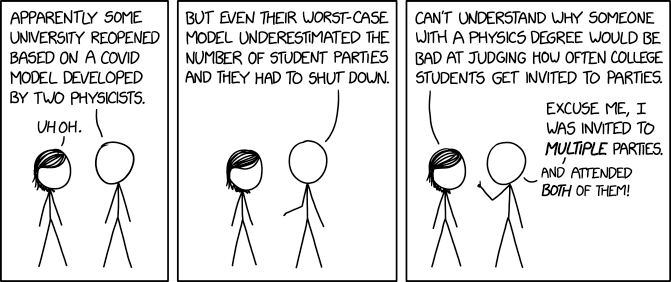
BTW, xkcd ventures a guess as to why an optimistic model on schools turned out to be so wrong ...


High Schools

You can check out this NY Times Safe Schools Dashboard, which tries to show which areas are likely to be safe for opening up schools. It also shows some interesting stats. According to the map, it claims that my county of Forsyth should be safe to open up elementary schools, but not high schools yet.

I believe part of this is based on studies similar to the South Korea study showing that kids in the 10-19 age range are just as likely to spread the virus as adults are. And sure enough, we've seen several reports of immediate spread in the first week of high schools opening up, often resulting in moving studies back to remote.

These children have a much lower incidence of death, but can still be a vector, bringing home the sickness to their more susceptible parents and grandparents.

That same study seemed to indicate that kids in the 0-9 age range do not spread the virus as much, and thus the reason why elementary schools may be able to open sooner.

My child's high school is still holding remote classes. She really misses in-class learning, being with friends, and marching in the band. Though, with football season being moved to the Spring, there's hope that she may still get in some marching this school year. BTW ... I think marching itself could be quite safe, being outside and all, however inside practices could spread the virus as well as possible crowding in the stands.

Many have pointed out that schooling from home can be detrimental to the child's learning, and I can see why. It would be good to find any way to get them safely back to school.

BTW, you can keep up with developments among high schools across the states in this impressive database being maintained by the NEA. It attempts to report case counts and death counts (if any) from each individual school. Just look up your state and see if there are any reports for your school. (Note: if your school is remote, there's unlikely to be any reports yet.)


Conclusions

These younger students are less likely to die, but they can still get sick, and can still spread the virus, even if asymptomatic. Schools can be safely reopened if there is adequate preparation, cleaning, contact tracing, low-enough new case volume in the surrounding community, mask-wearing (for now), distancing, adequate ventilation inside, washing hands frequently, etc. Schools that fail to do this will spread the virus and/or end up closing. Those who succeed can enjoy having the students return safely.

I am happy to see overall counts dropping, so perhaps by January we can get our kids fully back in school. If we work hard now to keep counts low in the upcoming dangerous fall/winter months, it could help our kids get back to school much sooner.

Saturday, September 5, 2020

Coronavirus Newsletter - Trump's Report Card


General Update / Trump: What He Did Right / What He Did Wrong / Final Grade / What About Biden?

Yes ... I know that the virus doesn't care about politics, and yes ... politics should be entirely separate from the virus. After all, the virus only cares about lungs and nom nom nom, whether we be Republican, Democrat, white, black, Asian, gay, straight, devout Christian, Muslim, atheist, or whatever.

But unfortunately if there's anything 2020 has taught us is that politics can and does determine how successfully the virus can spread. Some policies give the virus more lungs to infect, and some policies do a better job at protecting people.

So now we'll take a good look at how Trump has done, and give him a grade for his biggest test of his career.

But first ...

General Update
Deaths are slowing down, and New Cases are showing the very first signs of starting to speed up again. Worldwide, several countries in Europe are seeing resurgences. Brazil and Peru seem to be the most ballistic at the moment.

In the US, it looks like it's time for the midwest to have their turn at being the center of attention. The south is still trying to go down in counts, though my state of NC continues to struggle because of school outbreaks.

I guess that's all I got right now for updates ... so ...

What Trump Did Right
Next we must all realize that most everyone who is passionate about this subject wants the best for the people of the United States.

We may all disagree as to the best strategy. On one end of the spectrum, some believe that not even a single person should die from this disease, so we must all lockdown until it's all over in 4-6 weeks. And on the other end of the spectrum, some believe that we should ignore the virus, change no habits, and let our healthy immune systems take care of it.

However, we have a long history of pandemics, and other lesser breakouts. We have knowledge, experience, and experts who dedicate their lives to learning and stepping in to protect people from these sicknesses. These experts keep up to speed on the differences and similarities between outbreaks, and believe it or not, there are more similarities than differences, and thus we are able to use time-tested strategies.

For example, we know that universal mask wearing is effective with SARS coronaviruses, but not so much with influenza. We also know that identifying exposed people and quarantining them is very effective with practically all outbreaks, which means testing and contact tracing are vital to success. Lockdowns are only supposed to be used in emergency situations where other methods fail.

So, what about Trump?

I think he actually started out strong. At the end of January, he instituted travel restrictions against most parts of China. And he also instituted heavy quarantine measures on anyone exposed to the virus, while his opponents accused Trump of being racist or xenophobic. At the time, it seemed that Trump was the one overacting (good), and the Democrats were mocking him. (Though, isn't it funny that the Democrats are silent on all the countries that now have travel bans against us at this time?)

It was clear in early February that Trump did not want this virus in our borders, and I believe that his actions did indeed delay the spread of the virus for about a month compared to Italy and Spain whose cases shot up like a big explosion. Later in mid March, he increased travel restrictions to include most of Europe. He also instituted a 15-day "Slow the Spread" campaign encouraging social distancing and no groups larger than 10 people.

As the disease progressed late March/April, Trump (eventually) made sure there were plenty of supplies for New York, and he also mobilized military personnel to assist and set up makeshift hospitals to handle overflow. He also provided daily coronavirus briefings to keep the states informed on the latest developments.

In early April, Trump announced Operation Warp Speed, an effort to expend resources in an attempt to speed up the development of a safe vaccine against COVID19, though it's unclear to me how much this has helped the three vaccines currently in Phase 3 trials.

Up until this point in April, it really looked like Trump was mostly sincere about the fight against the virus, but then as soon as cases and deaths started to go down, he just seemed to stop caring.

What Trump Did Wrong
Despite the evidence that Trump tried to fight the virus through April, he wasn't consistent. From the beginning he wasn't perfect, though I'd say his handling was average through mid-April. He could have acted faster, pushed the "Slow the Spread" two weeks earlier, helped to push more testing earlier to help identify and quarantine.

The earlier containment strategies weren't the best. My favorite story was when our administration decided to rescue Americans off of the Diamond Princess mid-February. They loaded up a couple buses with everyone who had tested negative for the virus. But as they approached the planes, word came out that 14 of the passengers just then tested positive.

And remember what the rescuers did? They decided to go ahead and bring the sick people home. The 14 were placed at the very back of the plane with a plastic sheet to separate them from the rest of the non-infected passengers. Oopsies! Nom nom nom!

And as usual, Trump has been inconsistent throughout the whole epidemic with his tweets and strange utterances. For example, as early as March 9, he tweeted some stats from Fox News:
"So last year 37,000 Americans died from the common Flu. It averages between 27,000 and 70,000 per year. Nothing is shut down, life & the economy go on. At this moment there are 546 confirmed cases of CoronaVirus, with 22 deaths. Think about that!"
I think this confused the general public. People did think about it, and they resisted safety protocols.

When Trump was pushing hard for the drug HCQ, and immediately after, there was an uptick in poison calls from people ingesting a fish chemical with a similar sounding name. And when Trump talked about detergents, again there was an uptick in bleach poisoning.

It all just shows how influential utterances from the President can be. It's part of the job, so when Trump shows that he personally can't take the virus seriously, it inspires practically all of his base to likewise not take it seriously -- and the result? More spread of the virus. Nom nom nom.

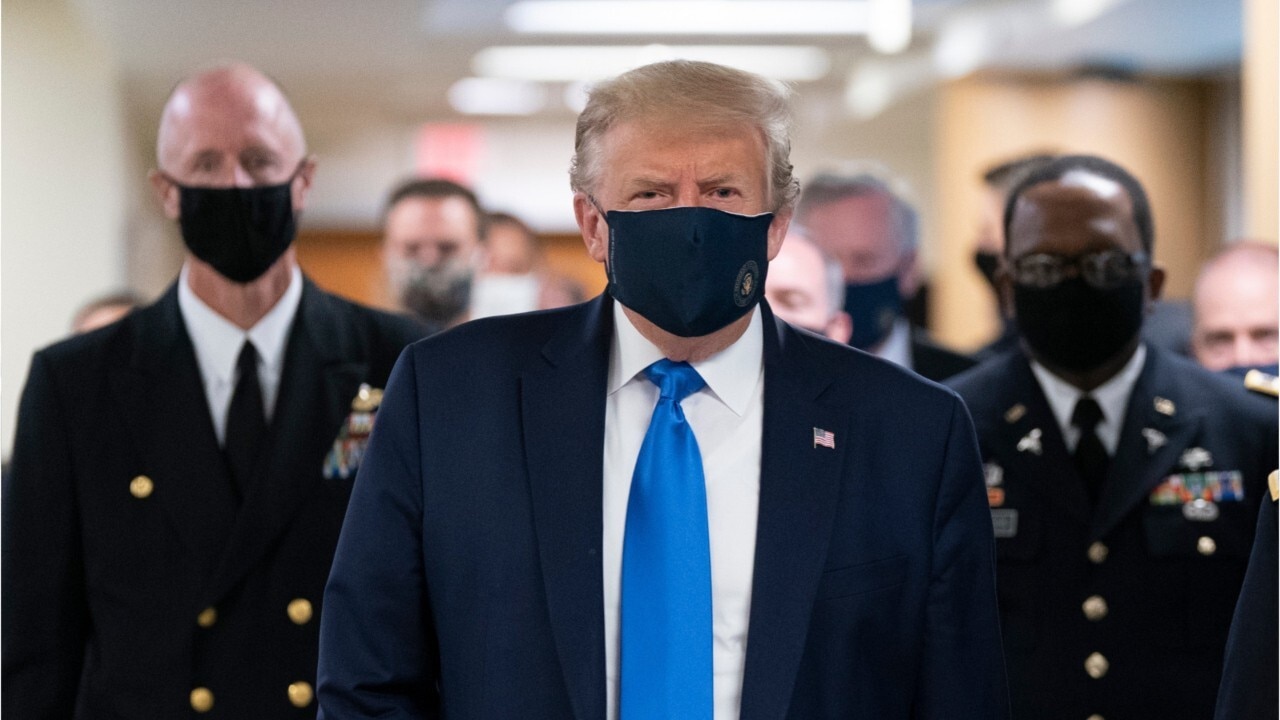
One day Trump says, "You should be wearing masks," and then the next day, he can't be caught dead wearing a mask, and even goes so far as to imply that NOT wearing a mask is showing support for himself. Even a couple of days ago in a rally in Pennsylvania, Trump again mocked Biden for wearing a mask everywhere he goes, and how stupid he looks.

So -- which message are we supposed to believe? The one where Trump is serious and says, "Wear your mask"? Or the one where he's joking around and saying, "Masks are stupid"? When provided with two conflicting messages, the general public is going to pick the one they want to hear most. (Nom nom.)

If it were just saying stupid things and being a little lax at the beginning, I could probably cut Trump some slack, but this is not all.

In mid-April, when Trump was hoping to reopen the economy by Easter, even though the base of Active Cases was still very high, he first indicated that he was going to force every state to reopen. But then the very next day he said he was going to leave it up to the states' governors to decide how to best reopen. But then again the very next day after that, in response to some lockdown protests, he tweeted on April 17:
LIBERATE MICHIGAN, LIBERATE VIRGINIA, LIBERATE MINNESOTA. 
This wasn't just saying something stupid, but rather a direct attempt to incite an insurrection against the very governors he purported to be free to proceed as they saw best. And ever since then he has been openly critical about "liberally run" cities and states that are slow to reopen ... even threatening to cut funding on schools that don't resume in-person schooling.

If anything, after mid-April, Trump has shown an enormous and complete lack of support in the efforts of local states and cities to do what it takes to eradicate the virus, which in and of itself contributes to the spread of the virus. Nom nom nom nom. Yeah.

And ... this is very important to understand ... I know why Trump is doing this. It all started mid-February when the global stock markets crashed. The market was his pride and joy, knowing that if the stocks are down, so are the chances of his reelection. That's when he started painting more of a rosy picture ... when he went from overreacting to under-reacting ... (and incidentally about the same time the liberals started taking it more seriously -- except for Pelosi?).

So, he has been downplaying the virus for months now, just so the markets can come back up and save his election. In other words, he has been choosing to take these actions to benefit himself ... not to save you and me from the virus, but to make the numbers look good for his chances. Don't believe me yet?

Just look at his campaign trail of death. In June, he held a rally in heavily-infected Tulsa, OK. Free masks were available on request, but everyone got the message -- if you truly support Trump, don't wear the mask. The organizers of the event negated their agreed-upon safety precautions by removing safety tape from social-distancing empty chairs so the participants would be allowed to cram together.

Trump knows that a well-attended rally drums up support, so he wasn't going to let a non-existent virus stop the perception of a lively event. Again, more proof that his own reelection was more important than the safety of the people. During the rally setup, several of Trump's staff -- organizers and secret police -- caught the virus, and a noticeable surge hit Tulsa shortly after. It was about the same time that Herman Cain caught the virus and subsequently died. He could have also picked up the virus at any of the other events held in Arizona and elsewhere that week.

At the Republican Convention in Charlotte, reports are already coming in of virus spread during the event. I haven't heard anything yet from the DC gathering for Trump's acceptance speech, but just give it time. Again ... trying to ignore the virus doesn't stop it from munching on lungs ... nom nom nom.

Also recently, Trump has added a new member to his coronavirus task force -- not an epidemiologist, but rather a radiologist? He doesn't know much about epidemics, but he sure knows how to pretend to know, and had been quite loud on Fox News. Trump liked what he saw, so he welcomed Dr. Scott Atlas on board. Evidently, he has been instrumental in pushing for some of the more recent policies to downplay the virus. It's almost as if the Emperor with the New Clothes desired to hire someone to tell him that he indeed is wearing clothes.

Dr. Atlas, it seems, was the one who recently forced the CDC to announce the guideline that asymptomatic people no longer need to get tested, even if exposed to someone with the virus. Seriously? Nom nom nom.

https://www.nytimes.com/2020/09/02/us/politics/trump-scott-atlas-coronavirus.html

And this will be my last observation in this section. The CDC is a federal department that reports to the President. As such, Trump has corrupted guidelines and instructions issued from the CDC. The one I just mentioned above was one instance -- one in which the Director Redfield was vehemently opposed.

Another case involved guidance removed from the CDC guidelines for reopening churches. The CDC had a paragraph warning against the dangers of singing in church, being proven to be superspreading events. Evidently the Trump administration had the paragraph removed because of concerns that it might be seen as trampling on First Amendment religious rights. (Nom nom nom.)

https://www.npr.org/sections/coronavirus-live-updates/2020/05/29/865324310/cdc-quickly-changed-its-guidance-on-limiting-choirs-at-religious-services

Final Grade
There is so much "little" evidence against Trump, I'm struggling to bring it all together into this one blog post. All you have to do is open up the news and you can see the latest and greatest tactic Trump is using to promote himself over the safety of his constituents. Yet, the most interesting thing is that his base can't see any of this. Trump can do no wrong.

But to tell you the truth, even now I could delete that whole last section above and just present the following evidence, and by itself it would be enough to condemn Trump -- it would condemn any leader of any country that had the results you're about to see.

For months now, I've been tracking the total COVID deaths per million for several countries. This is much more appropriate number to track than total Cases reported or even total Deaths. Seeing it on a per-capita basis takes care of the issue of the US having a relatively large population. And Death counts are much more accurate than Case counts -- the last of which depend on testing, which rates vary between each country.

My source comes from the data at this website: https://www.worldometers.info/coronavirus/

And here is what my latest compiled graph looks like:


I start counting when a nation reaches 1 death per million to put each country on the same basis. The US is the bold green line with the currently steep upward slope. At the beginning of this week, the US ranked 9th place in the world for this stat. (Note that this excludes San Marino and Andorra, which are very small countries -- their high stats don't make sense in this context.)

But in the last couple of days, the US just now passed Sweden, and in a few days will bypass Italy as well, putting us in 7th place. It may even bypass Spain and the UK (and Chile) in a couple of weeks, placing us in 4th place. Not pictured in this graph are Chile at 600, Belgium at 854, and Peru at 894.

And keep in mind that this is out of 156 countries that have 1 million or more population (anything under that amount fails in this analysis).

That means by this stat alone, our current 8th place means there are 148 countries that are doing better than us. Also for comparison, Germany -- that curve just above 100 -- ranks 41st place, leaving the vast majority of countries below that line. The average for the whole world combined is 112.8 deaths per million. The US is at 580 deaths per million. 5 times more than world average!

There's just no way to spin this except to say that whoever is in charge of this country is doing a terrible job. He isn't doing whatever all these other countries are doing, and people have been dying from it.

The results speak for themselves. We're doing really poorly, and many experts are saying that we're not even halfway done yet. Is it possible to start doing what some of those other countries are doing? Maybe -- but not likely under the current leadership, and the confusing messages being sent to our public, and the lack of support in all the right places.

Trump's final grade: F

He doesn't even get points for trying early on. In fact it's so bad that I believe if Ebola were to hit us now, like it did in and around 2014, I think we'd have a humanitarian disaster on our hands. I do not feel safe.


What About Biden?
Are there any good alternative candidates that may more effectively fight the virus? If anything, I think Biden couldn't do worse. He is already running on the platform of issuing a nation-wide mask wearing mandate, not unlike what many successful countries have done.

He also evidently has a 8-step plan that he says will reopen the nation safely.

https://joebiden.com/reopening/#

I definitely prefer his proposals over Trump's plan (wait -- does Trump even have a plan?). But some items on his list might be a little overkill, and I really think we could benefit from the Google/Apple automated contact tracing app -- it could really save us a lot of time and help the human contact tracers.

And as I said before, the trifecta of masks / testing / contact tracing are together what get the best results in the most successful countries. Biden's plan almost sounds like that.

Saturday, August 29, 2020

Coronavirus Newsletter -- Contact Tracing


General Update / Contact Tracing: Intro / Digital Solutions / Privacy Concerns / Apps in the US

Today, I've decided to concentrate on contact tracing ... see if I can break this down into understandable chunks. It's been a while since we've heard about this on the news, but it's still a vital tool in the fight against epidemics of all kinds.

General Update
Overall, new cases are dropping. Active cases are still trying to go down (a good development). Deaths are still climbing at about the same rate, but should start going down sometime soon.

A lot of new cases seem to be associated with colleges and high schools opening up. For example, even though NC is roughly stable overall, the counties with schools are showing much higher activity.

Iowa, South Dakota, and North Dakota have blown up like crazy.

Everything else is about the same as usual.

Both presidential candidates in the last couple of weeks have presented comments on the coronavirus -- you can probably guess which candidate agrees with me, and which one is clueless. But neither one of them talked about contact tracing, and that concerns me a little.

Contact Tracing: Intro
So, what is it? Contact tracing has been around for centuries. The idea is that in order to stop a disease from spreading, you employ a little detective work to find out where the sickness came from and where it's going. Then you can figure out who to isolate and/or quarantine.

Hundreds of years ago, it was more difficult, but as technologies advanced, people could use tools to aid and speed up the effort, and save more lives. Imagine investigating an outbreak, figuring out the patterns and homing in on Patient Zero (remind you of any movie plots?).

At the beginning of the COVID-19 outbreak in the US, you probably heard some of the contact tracing results in the news, such as how the one nursing home in Washington infected several visitors who then took it to different cities. You may also remember that in these early stages, these people were quickly put into quarantine so that couldn't infect others.

Ultimately there came a time in late February when it became clear to everyone that the virus was loose and everywhere. It seemed that contact tracing stopped, but not really. It mainly happens in the background, but we still hear reports of "clusters" in the news. These are areas where it becomes clear that someone at some place infected many -- such as a nursing home, church, or parties.

And how do we know that these clusters are responsible and not a coincidental convergence of people who had already caught the virus from other places? It's because of the patterns. Whether you use Bayesian inference, Occam's Razor, or whatever you want to call it -- if you can see one group over here that's infected, and this adjacent group of people are not infected, it's very, very likely that the infection happened at the first gathering.

Or put in different words ... recently we've just had high schools open up. All of the kids start off healthy, but then within the first day, John's class has an outbreak of 10 kids, and Susie's class down the hall has none. Wouldn't it make sense to assume that someone in John's class infected the other 9, and that it happened in John's classroom? It would at least be the easiest explanation.

On the other hand, if every classroom showed infections in the first week evenly spread out, it's actually simpler to believe that the spread happened before the kids even came to school.

And guess which of the two patterns are being witnessed. If you answered that it's the chunky here and there outbreak pattern (rather than the everywhere pattern), then ... ding, ding, ding! You get a star.

That's contact tracing.

Contact Tracing: Digital Solutions
We Americans are actually pretty good at contact tracing, and practically anyone can be trained on how to do it. In fact, in response to the current pandemic, hundreds of thousands of people have been hired to do just that. And it really is amazing how we can find these patterns effectively.

But there's just one problem ... it's too slow. Very slow. By the time we figure out a cluster, it's too late. The virus has already spread and is likely starting the next set of clusters. Especially with asymptomatic spread, it becomes very difficult to beat and get in front of this virus. And that's why we currently have millions of people with active infections.

However, we have the technology to speed things up dramatically. In fact we could have already been done with the virus, and back to our normal fully open economy.

China and South Korea are extreme examples of countries who have used advanced technology to efficiently combat the virus.

Parts of China use a mandatory tracing app in conjunction with high-tech surveillance and Artificial Intelligence (face recognition) ... just like you may have seen in the TV Show "Person of Interest." When an infection is identified, the system goes through history of phone locations and video surveillance history to home-in on people most likely to be infected, and sends their phones a signal to trigger a red/yellow/green indication.

Green means "perfectly okay and able to do anything they want." Yellow means "intermediate risk of infection, and is restricted from certain activities." And red means "infection imminent, must stay in quarantine." And the result: they've gotten active cases down to practically zero, and new cases at a slow very manageable trickle.


South Korea has likewise incorporated their own surveillance and mobile phone system to battle COVID -- very similar to China, though not quite as invasive. They've done an excellent job keeping the virus at bay, all while avoiding a total lockdown (though they have shut down individual businesses when infected as well as hotspots like bars in some locations).

But get this -- after their initial first wave and after they began instituting their system, South Korea has had two further noticeable outbreaks, and they both involved a collection of people who had circumvented the contact tracing setup, allowing the virus to spread. The first outbreak (a little one) involved LGBT concerns, starting with gay bars, which then inspired infected people not to cooperate, being unwilling to out their LGBT friends. It took about a month or so to bring cases back down. The second outbreak (much bigger) involved a big church in Seoul, caused by a desire to stop safety precautions and let people have the freedom to do whatever they want (sound familiar?). I'll write about this in more detail next week. It'll likely take at least another month if not two to bring these cases back down again, but I have faith ... as Korea is demonstrating that the technology-aided contact tracing works ...

... as long as the people cooperate.

Contact Tracing: Privacy Concerns
Up to now, if you're a red-blooded American like me, you're probably saying, "This would never work in the USA," and you're probably right. In fact, at the end of that video on China I shared above, it talks about how part of the code is sending location and timing information to the police, though not being disclosed to the participants.

So, yes, it's scary. I think this is why both the Republicans and Democrats shy away from this type of technology. There's no way we could institute anything that would violate our privacy and jeopardize our rights and freedoms.

If only there were a non-invasive technology solution -- some kind of compromise. But wait ... there is!

Google and Apple have worked together to produce such technology -- the backbone of an app -- and it's already installed on all Google/Apple phones with Bluetooth that has upgraded in the last couple of months. (Don't worry -- it's useless without an app to activate it.)

Before you get scared off, you need to understand how it works. And you'll have to believe me when I say that in terms of privacy, this technology is much more secure and privacy-protecting than practically every single app you're already using on your phone.

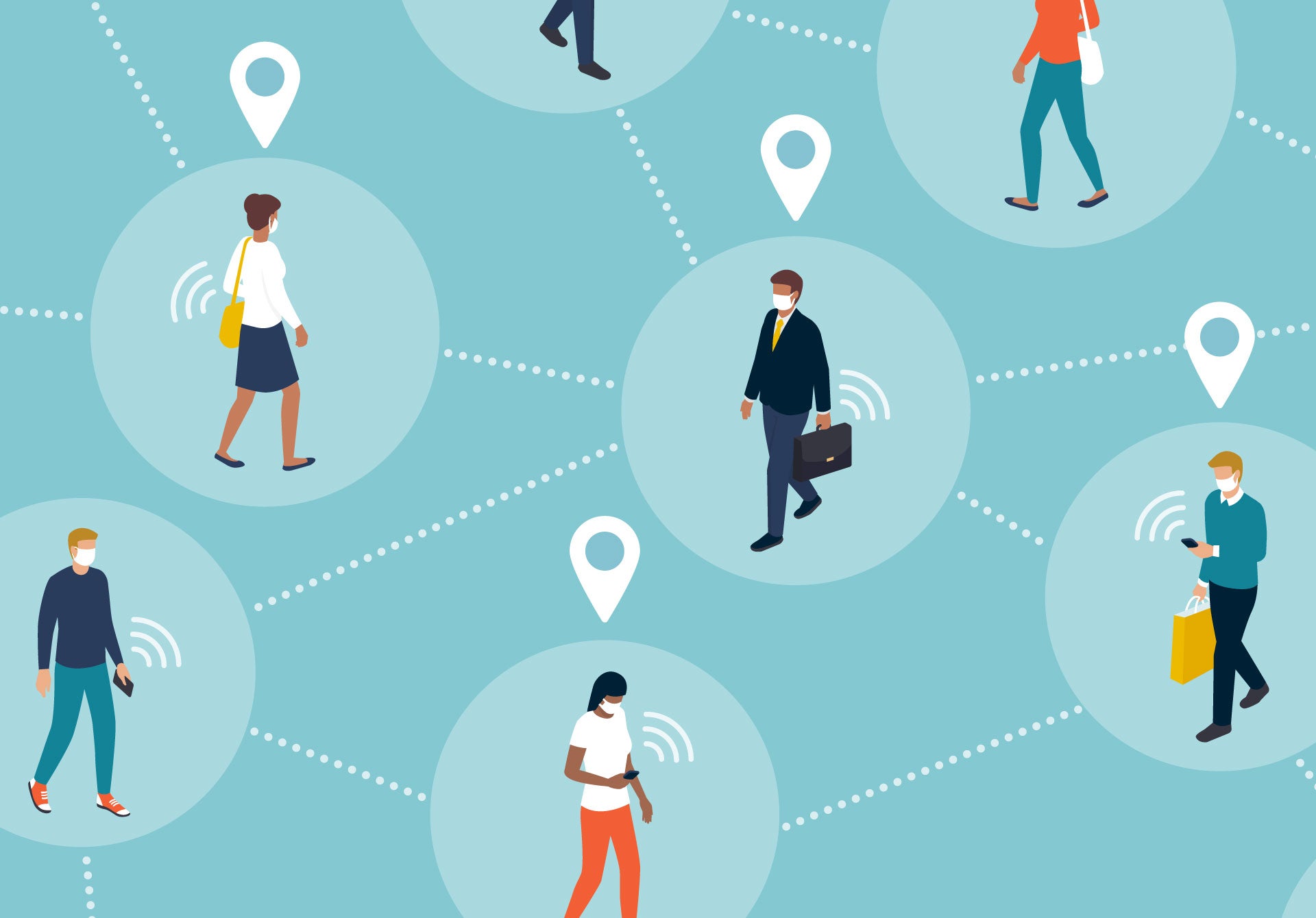
I found this cute graphic that explains the idea in simple terms ...


Just in case this picture expires, I'll repeat it here in my own words. Each phone creates its own random string, and nobody knows who this string belongs to -- not even the central database.

As you walk around, your phone's Bluetooth will talk to other phones and swap random strings, and stores the information for 14 days. So after a couple of weeks, your phone has a collection of everything your phone has broadcasted, and a collection of random strings received from other phone, and also possibly how close you were and how long the encounter was.

If you catch COVID-19, your phone sends the 14 days worth of "sent" strings to the central database. Keep in mind that nobody knows who sent which messages, and absolutely nothing can be traced to anybody. But how do the other people find out that you got COVID-19?

Simple ... their phones will check the central database -- if any of their "received" messages matches what's in the database, they will get a message: "You have been exposed to the virus for 10 minutes -- you should get tested" -- or perhaps some other message: "You need to self-quarantine for five days."

But in no case can the sent or received messages be hacked to reveal its sender ... it's mathematically impossible. This is similar to the double lock and key encryption methods used to secure communications daily. That works like this: Sender A puts a lock on his message and sends it to Receiver B. Then Receiver B puts a lock on the message and sends it back to Sender A. Now there are two locks on the message. Then Sender A can unlock his own lock, send it back to Receiver B. And finally Receiver B can unlock his own lock and read the message. No one else can intercept this message because either Sender A's lock or Receiver B's lock will be on the message.


Of course, there exist higher-level hacks or indirect hacks that can take advantage of any secure setup. For example, Criminal C in the message scenario above can pretend to be Receiver B and use his own key to get the message instead of Receiver B. This happened to me once when I went to a bad Yahoo News page and typed in my credentials to join a discussion -- my email account had been hacked.

And there are ways to trick a COVID app -- such as broadcasting a false positive report just to be malicious (though we could lock that down by requiring a doctor's key to send a positive report). Also, human contact tracers might be able to find out where you've been if a whole bunch of other people from that same place test positive at the same time -- not through the app, but through good old fashioned detective work.

Despite these high-level hacks, people still can't get any of your personal information -- it is safe in that respect. Compare that to the apps you love to use today, but then you get bombarded by ads about those items you Googled yesterday. Now, those are apps that know who you are.

Here is an official announcement from Google/Apple explaining in their own words how their Exposure Notifications System works (repeating a lot of what was said above):


Lastly, I must point out that no COVID app can run effectively without the backing of the government. Everyone has to use it. If everyone is using different apps, it just wouldn't work, as App A can't see App B. Several countries in Europe either use the Google/Apple technology or something similar to it, and countries using the same technology may be compatible with other countries. See this article for more details:

https://www.reuters.com/article/us-health-coronavirus-europe-tech/europe-pins-hopes-on-smarter-coronavirus-contact-tracing-apps-idUSKBN23B1OA

Contact Tracing: Apps in the US
In the US, alas, there is no national tracing app, so that framework sitting on your phone right now is doing absolutely nothing -- just sitting there. Each individual state is handling contact tracing in different ways. Starting in August 2020, some states have started using the Google/Apple technology. Virginia was the first with Covidwise. And then North Dakota moved from their privacy invasive solution (Care19 Diary) to the Google solution (Care19 Alert). And supposedly, 20 states are in the works to launch their own versions soon.

Other states are using home-grown apps, which are usually on the invasive side, storing location information (and in the case of North Dakota actually selling the information to 3rd parties), and they really aren't that good. Some involve filling out questionnaires, but no real tracking.

And some apps actually mimic Google/Apple.

Here's another article on states using the Google/Apple solution ... I strongly recommend reading it and watching its embedded video to get more information.

https://www.washingtonpost.com/technology/2020/08/17/coronavirus-exposure-notification-app/

In my opinion, the Google/Apple based apps are the safest to use in terms of privacy. Some of the other apps (not Google/Apple) being used throughout the states may have other invasive features added, such as sending GPS location or phone numbers. If at all possible -- you want to stay away from those apps because they really are invading your privacy when a much safer alternative exists.

Here's a quick list of public apps I could find in the US:
  • Alabama: GuideSafe (Google/Apple)
  • Alaska: COVID Secure (sounds invasive -- you can receive notifications of positive test results from friends and employees, and location collection unknown -- claims information is "safe" on their servers -- sounds mandatory in some cases)
  • Arizona: Covid Watch (Google/Apple) -- limited locations -- only college campuses?
  • Florida: CombatCOVID -- sounds similar to Google/Apple, and they claim not to use or collect location information, but I'm having a hard time finding out for sure. And right now it's only being used in the southern counties.
  • Nevada: COVID Trace (Google/Apple)
  • North Dakota: Care19 Alert (Google/Apple) and optional Care19 Diary (location -- don't use it)
  • Pennsylvania: Coming Soon (Google/Apple)
  • South Carolina: Coming Soon (Google/Apple)
  • South Dakota: Care19 Diary App (location -- don't use it)
  • Utah: Healthy Together (location -- don't use it -- hardly anyone uses it)
  • Virginia: Covidwise (Google/Apple)
  • Wyoming: Care19 Alert (Google/Apple) and optional Care19 Diary (location -- don't use it)
I actually spent quite an amount of time trying to expand this list, but realized it was taking up too much time. If your state provides a state-wide app, please let me know and I'll add it to the list. I've found that most states don't have anything. As for NC and GA (two of my favorite states), nothing appears to exist outside of college campuses.

This alternative app also looks interesting, but I'm not sure where it's being used other than college campuses: NOVID. Instead of using Bluetooth, it uses the microphone to pick up high-frequency signals from other phones using the same app.

Will these apps work? This is still up in the air, though Europe seems to be doing well with them (until a country stops using them). We'll see if they continue to catch on.

So, keep an eye out ... if you see an app in your location that protects your information as I described above, then go ahead and turn it on, and help us defeat the virus. It would really help us to more fully open up our economy without giving much up in return -- it seems to me to be a no-brainer.

If you have any questions, or would like for me to explain any aspect of these apps, just let me know.

Keep well, and stay safe!

Saturday, August 22, 2020

Coronavirus Newsletter -- Herd Immunity


General Update / Herd Immunity: What Is It? / Achieving It / 20% Theory / An Alternative / What Comes Next?

The good news is that new cases are down, deaths are slightly down, and with recoveries increasing, active cases may be going down soon. It's enough to tempt some to think this thing is finally ending, but not so fast ... there's actually much more opportunity for this virus to spread -- as you'll learn about shortly.

Today we'll be talking about herd immunity -- what is it? How close are we? How, if ever, will this pandemic end? But first ...

General Update
The hotspot map for the US is lightening up overall, though a few places are still showing high activity: east Georgia, west Tennessee, northern Florida, east Texas, northern Mississippi, eastern Oklahoma, splotches all up and down the mid-west, highway corridors of Idaho and Washington, and central California.

Louisiana is looking much better, and maybe Alabama as well.

I'm sad to report that South Korea has had a resurgence, mainly due to a large non-compliant church in Seoul -- I may talk about this next week -- I'm still thinking about what next week's topic will be. I have full confidence that Korea will get on top of this and get back to being awesome.

Spain is having a major resurgence, which may be similar to our mini-second wave. Japan has had a second wave that makes the first wave look like little stuffs ... and deaths have already started picking up.

Brazil at its current rate is likely to surpass the US in total death counts in the next month or so, and then Mexico and India may be next to surpass the US.

But enough of this diddling ... let's get on to herd immunity.

Herd Immunity: What Is It?
This term -- herd immunity -- has been floating around the news for months now. Most of the time, it seems that people don't really understand what it is or what it means.

In a nutshell, herd immunity is supposed to describe a situation in which so many people become immune that the virus has a harder time finding people to infect and starts to die out.

More technically, herd immunity is when the current reproductive number falls below 1.0 under normal circumstances (no lockdowns, no restrictions, economy fully open, etc.). Or another words, active cases start dropping on their own.

Check this picture out from worldometers.com, as it will help to understand the terminology.


This shows currently active cases for the United States. You can see our first wave from March to May, and then as recoveries started kicking in and new cases dropped, active cases went down for a few days. I remember being excited about it, but then the second wave started. Now near the end of August, it looks like we're at another turning point. Maybe it'll start going down this next week. Eventually, we could get it all the way back down to zero.

The end of June, and the end of August (I hope) are what I'll call moments of artificial herd immunity. What this means is, we, as a society took artificial measures to slow down the spread of the virus. The first immunity in June came from nearly-nationwide lockdowns through mid-May, which successfully brought down daily new cases to lower levels. The second immunity that might come next week is likely a combination of continual self-distancing, warmer weather, and wearing masks more consistently.

But this isn't a "true" herd immunity, as that can only be measured when there are no artificial measures being taken ... that is, no masks, no distancing, etc. In other words, if we were to do away with our current artificial measures, cases would likely continue increasing until we hit "true" herd immunity.

And even then, it's nearly impossible to pin down "true" herd immunity because of a wide variety of factors. You may have heard that we need at least 60% infected to achieve this immunity, but in some areas where population density is lower, it could happen at 40%. In more dense areas like New York City, it would probably happen more like at 80%.

Weather can also play a role. There appears to be evidence that hot weather does indeed slow down the virus, so herd immunity can happen sooner. But as soon as cold weather hits, a higher threshold might be needed.

So, pinning down the exact immunity percentage needed for herd immunity can rely on an ever-changing set of complex variables.

BTW, You're probably wondering how experts estimate the herd immunity percentage. Well, have no fear, I'm about to reveal all.

It all comes from the SIR model. To understand this model, I've found no better video than this one I've shared before on my Facebook page:


In this video, herd immunity is represented in the "do nothing" scenario when the orange Infectious curve starts to go down. The initial Reproductive number, usually called R0 (R-naught), represents the speed of infection at the very beginning of an epidemic. Some people think of this as an average number of people one person may infect over a certain amount of time. As the disease increases, the Reproductive number will drop as more and more people become immune. This is usually called Rt (R at time 't'). And herd immunity happens when Rt falls under 1.0. You can think about it in this way ... if Rt = 0.9, then one person is infecting less than one person -- in other words, the virus is going to die out -- if I infect 0.9 people, they're going to infect 0.81 people, who will then infect 0.729 people, and so on until it dies out.

And after running all these SIR models, and even comparing with actual epidemics, epidemiologists have come up with a nice formula. If you can measure R0 at the very beginning, then the needed herd immunity threshold happens at 1 - (1/R0).

Example: Measles has an estimated R0 of 12-18, which provides an estimate of herd immunity at 92% - 94%.

For COVID-19, R0 is estimated to be from 2-6, which translates to herd immunity at 50% - 83%.

The Spanish Flu was estimated to be from 1.4 - 2.8, with herd immunity from 29% - 64%.

You can get all the boring details of R0 and the herd immunity formula in this wiki article.

Before moving on, I need to clear up one more misconception. Some people seem to think that when we get to herd immunity, people will stop getting sick, but that's clearly not the case. In my 0.9 example above, the 0.9 people I infected in turn infected more and more people until a total of 10 are infected before it dies out.

Or think of it this way -- if I haven't yet gotten the virus, and we've hit herd immunity, and if I lock myself in a room with an infected person, do I somehow become magically protected? I hope you answer no and realize that people will continue to die even when we hit herd immunity.

Herd Immunity: Achieving It
So how do we get there?

The easiest way is to just do nothing ... open everything up, and let the virus run its course. This is indeed an option -- in fact, many have suggested it. The UK tried this approach from the beginning before resorting to lockdowns, and as a result has one of the highest deaths per million in the world. Sweden also kind-of tried a version of herd immunity, which also led to similarly high deaths per capita.

The idea is that if it happens quickly (but yet slow enough to where our hospitals can handle the demand), then we can get it over with and then watch the virus die out in the end.

Another variant is to introduce vaccines -- to help people become immune. Say we need 70% for herd immunity. If 20% have already caught the virus and 50% get effectively immunized, then that would bring us up to 70% -- it doesn't matter how people become immune -- it just needs to get up to the threshold.

We've already tried artificial means to obtain a lower artificial herd immunity, but if the artificial means are relaxed too early, then the virus begins spreading like before. These artificial means include lockdowns, wearing masks, washing hands more than usual, quarantining the sick and exposed (which requires effective contact tracing and testing).

Herd Immunity: 20% Theory
Before on my Facebook page, I shared a popular theory that's been going around ... that herd immunity for COVID-19 may be closer to 20%. Here's a good summary of that idea:

https://theconversation.com/coronavirus-could-it-be-burning-out-after-20-of-a-population-is-infected-141584?fbclid=IwAR39_cLMtgb0rr4VOUpy_0tzJWPPkpeO0za_bS5h7qYnQ21h0cFJi3ym6bc

In several instances throughout the world, it's been observed that, according to antibody studies, only 20% of the people got infected, and then the virus disappeared. This has apparently happened in New York, Stockholm, London, and even on the Diamond Princess.

And look at Sweden right now ... they've probably hit about 20% exposure, and for some reason, it has suddenly died out. Could there be truth in this theory?

The idea is that most of us already have T-cell immunity from exposure to the earlier much-less dangerous coronavirus that causes a version of the common cold. That is, many of us probably already have T-cells that recognize the protein surfaces of this new coronavirus, because they are similar to most other coronaviruses.

I do think T-cells will ultimately prove to be key in helping to create a type of vaccine or protection once we figure it out, but after thinking about this more, I think the 20% theory is wrong, and here's why ...

  • I think we're seeing examples of artificial herd immunity. 
    • In Sweden, many people are self-distancing, which is artificially lowering the threshold. Also, lower population density is probably going to require a lower true threshold.
  • In some areas, antibody tests have revealed much higher exposures.
    • Some sections of NYC have shown exposures as high as 80%-90%. Perhaps higher density destroys the 20% theory? Or these sections of NYC were somehow unexposed to earlier coronaviruses?
  • I believe heat in some areas is contributing to a temporarily low immunity threshold.
  • And ... if T-Cells really are providing complete immunity (that is -- they don't even test positive for this virus or related antibodies), then it would have shown up in early calculations of R0. 20% herd immunity corresponds to an R0 = 1.25.
    • Then again, this virus is exhibiting a super-spreader pattern rather than a smooth spread pattern, which could by itself change the rules and make the SIR model less applicable.
  • And finally ... don't look now, but Sweden and a lot of other countries are starting to see resurgences. In a couple of months, I think we'll see that 20% is wrong.


Herd Immunity: An Alternative
I actually hate the idea of obtaining herd immunity, because I think the cost would be too high. The mortality rate for this virus is estimated to be in the 0.5%-1.0% range. If the entire population of the US were to catch this virus, that would be 330 million cases, which would then result in 1.65-3.30 million cases. If herd immunity causes only 270 million to be exposed before disappearing entirely, that would still be 1.35-2.70 million deaths. And right now we're just at 0.18 million deaths.

Also, if we let this get to herd immunity, it greatly increases the chances of it never ever going away. Just like the Spanish Flu, which has since mutated into other H1N1 strains, though we are much more capable of treating its symptoms and have really cut down on deaths.

The only other real alternative is eradication, which is basically obtaining a really low artificially herd immunity through artificial means for an extended amount of time until the virus dies out.

Other countries have shown that this is more than possible. China has practically eradicated several outbreaks. The US eradicated Ebola on our soil around 2014. With COVID-19, several countries had eradicated it, or gotten close: New Zealand, South Korea, Japan, China. Some of these countries have achieved this even without locking down. Though, it's also been shown to be difficult to maintain when other countries are doing a terrible job eradicating and reinfecting them.

Wearing masks, social distancing, effective contact tracing, taking on personal responsibility, and so on, have proven to be effective -- not only in fighting COVID-19, but also other recent outbreaks. If you watched that cool video above, then you've probably already seen that the "quarantine sick and exposed" scenario was the most effective way to fight the virus.

To me, it seems like the much preferred option. I think we could achieve it even now with smart strategies and safety precautions that would relatively quickly kill off the virus -- even before a vaccine is created.

What Comes Next?
So what do we do next? It's entirely up to us. If the entire world were to incorporate smart strategies at the same time, this virus would be gone in a matter of weeks -- not months. And then we could go right back to normal.

The only other option is to let the virus win and take us to full herd immunity -- and that only comes at a high price.

Friday, August 14, 2020

Coronavirus Newsletter -- Voting


General Update / Super Spreader Theory / Best Way to Vote

From now on, I think I'll stick with themes in these newsletters. Today that theme is voting, so everything will lead up to the discussion on voting.

First ...

General Update
Last week I expressed a little joy in death rates declining in the US, but evidently it's short-lived. They're on the rise again. Perhaps it was just a data anomaly (some states sending in revised death counts, or the like).

Looking at the NY Times hotspot map in their dashboard, it appears that the colors are getting less red. Most states are declining in new cases or holding steady. The South is still the worst place to be, though my own home state of NC may be doing the best in the South. Georgia, west Tennessee, northern Mississippi, northern Florida, most of Louisiana, and east Texas all still look pretty bad. Deaths in Georgia continue to increase.

Utah seems to be calming down. California is struggling, and so on, so on.

Overall, something does appear to be slowing down the virus considerably. I think it's the masks, but it could also be the really warm weather right now. We'll have to see ... most think another wave is still coming in the Fall, combined with the next flu season. Next week I'll tackle the question of herd immunity ... so stay tuned for that.

Super Spreader Theory
I'm sure you've heard the stories ... one person infects a large chunk of a choir in Washington. One man infects more than 70 people in South Korea as he visits several bars in one night. A sick guy goes to a family party, only to infect everyone there. Fitness classes infect 65 people. A conference helps spread the virus among 100 people in just two days. And so on.

But then this happens: my mother, a resident of a nursing home, had a roommate who tested positive. The staff immediately had my mother tested, and as soon as she tested negative, they moved her to a safer room. But that took more than 24 hours, during which my mother was confined in a closed room with another infected old lady "coughing up a lung." The beds were more than 6 feet apart. And get this ...

My mother never caught the virus.

How does that even happen?

Enter Super Spreader Theory.

Epidemiologists are a little confused when they study COVID spread patterns. With the flu, the spread is even and follows predictable patterns. But with COVID-19, it's kind of chunky, often with no discernible patterns. Kind of like how a tornado hits a house, skips one, and then hits the next house ... for no apparent reason at all.

Many say this is strong evidence that COVID is spread mostly through super-spreading events. In fact, they say ... get this ...

Only 10 to 20 percent of infected people are likely responsible for 80 percent of the spread!

But nobody knows what the rules are. Why does that person spread it, but not that person? Why did it spread so readily in that event over here, but not in that similar event over there? We have ideas, though.

In general, imagine you want to push a really heavy box. If you lightly press against it, it won't move. You have to push just hard enough to overcome friction, and then all of a sudden it starts to move. And once it moves, the friction decreases, and you don't have to work so hard to keep it going.

Similarly, it could be very possible that you pass by a really sick COVID person, and not catch it at all ... even with masks off -- which can happen if that sick guy hasn't reached whatever threshold is needed to pass on the virus.

One theory is that a person can become a Typhoid Mary, in which he doesn't feel sick enough to stay home, but something about how he breathes, or maybe something special about his body, makes it so that he spews the virus everywhere, and anyone close enough catches it.

Another theory is that it's not the person, but rather the event. If you go to an indoor event where people are together for a long time, then one person could possibly infect everyone in the room through aerosols, or hugging/shaking hands, or through some other vehicle. There's evidence that shouting or singing increases the chances of a super-spreader event occurring.

I realize this may sound kind of strange to you, but scientists are seriously considering this, as it would explain the chunky spread that they're witnessing.

To learn more about this theory, you can read more in these fun articles ...

https://www.nytimes.com/2020/06/30/science/how-coronavirus-spreads.html
https://www.scientificamerican.com/article/how-superspreading-events-drive-most-covid-19-spread1/
https://www.bbc.com/news/world-us-canada-53273382

The nice thing is that if we can understand what causes super-spreading, we can actually make better decisions and help our events not to be so risky. I think that's why we hear a lot about wearing masks, not singing/shouting, and staying outside. It all comes from Super Spreader Theory.

Best Way to Vote
Then it comes down to voting, which we know is a very important part of our nation. And this is happening during 2020, a very important national election. Many are concerned that we will experience a low turnout, which could swing the election in any direction. Or many may show up to the polls and spread the virus ...

... or will they?

Think about the last time you went to go vote in person. Was it an exciting event where everyone talks to each other, and sings and shouts? Or was it more like standing in long lines keeping quiet while you played on your phone? Voting, to me, is sounding like a non-super-spreader event. Once you get past the no-campaigning point, everyone is usually quiet, and everyone just wants to vote and get out of there as fast as they can.

If the "event" aspect of super-spreading is true, then without the singing and shouting ... and if most everyone wears masks, it may actually be safer than attending a protest rally where people are shouting with their masks off.

If, however, the Typhoid Mary theory is more correct, then voting in-person would be riskier.

Either way, it's definitely not zero risk. However, if voting is important to you, I highly recommend looking into the prospects of voting in person ... it may be safer than you think. Voting workers would be more at risk, just because they'll interact with everyone, but they could receive more protection in the form of PPEs.

The CDC supplies these guidelines to help make voting safer for everyone.

Also, ask yourself, if you think the benefits of attending a protest outweigh the risks, then what about voting? Is it worth the risks to vote in this critical election? A message to my more left-leaning friends -- keep in mind that the more conservative voters are going to be less likely to shy away from voting booths.

I, myself, am planning to vote in person unless I get sick in the interim.

And either way, I would not advise older people and those in high-risk groups to take this risk, so what other options are available?

Really only one ... absentee voting has been around forever. Some states, like Texas, require viable excuses or age requirements, but I think most states, like my own NC, do not require an excuse.

You can check here to get more information on how to do absentee voting.

Some states are loosening up excuse requirements, and making it easier to vote by mail. In some cases, the ballots are being sent even when not requested.

As usual, this brings out allegations of fraud.

Can dead people vote? I've seen plenty of Facebook posts -- one that shows 7 delivered ballots at a house where only 4 people live -- the other 3 are dead. The person posting says, "I could take one of these ballots and get a second vote." So why doesn't she do it? And could she even get away with it if she wanted to?

People have tried, but most likely if signatures don't match, the ballots are tossed out as invalid. It's one thing to receive ballots from a district that hasn't cleaned their rosters, but it's another when the ballot is actually sent in, which goes through a more thorough round of due diligence. You can read more here about why there isn't much evidence to support successful voting fraud by mail.

However, there's a big problem with absentee voting. Because of COVID, demand for mail services has increased drastically. At the same time, the USPS has decided to cut back on costs, meaning slower deliveries, which means if you mail in your ballot, there's a good chance that it will not make it in to the polling place in time to be counted.

So, you could be burned with a three-way lag. First you must request the ballot (which you can do online), and wait for them to put your ballot in the mail (lag #1). And then you must wait for the mail to be delivered to you (lag #2). Finally when you place it back into the mail it has to make it to the polling place (lag #3). All these lags can add up.


But luckily, there's another solution growing in popularity. Absentee voting drop boxes. After you fill out your form, you can take it to the nearest drop box and then you can bypass the USPS entirely. In fact, because of anticipated mailing woes, more and more of these drop boxes are being installed.

For some reason, people are still calling "fraud" even with these drop boxes that have been used for years without any issues.

I do find it funny that our president expresses his concerns for fraud, while at the same time actually attempting to introduce fraud with a "legal" facade. I'm surprised to learn of lawsuits going around trying to stop absentee voting (a long-standing tested tradition), the temporary loosening of requirements, attacking drop boxes, and so on -- and not to mention the idea of delaying Election Day, and also promoting the idea that Americans have a right to know who their next president is going to be before they go to bed election night (yeah ... that's not what the Constitution says).

I also know that if the president felt that mail-in ballots would help him, he'd do everything exactly oppositely ... force all states to install drop-boxes, hold the counts open until the USPS delivers ALL mail-in ballots, and so on.

But seeing that Democrats are more likely to use mail-in ballots (and avoid in-person voting), it is very easy to see that this is a downright blatant attempt at voter suppression. It also shows the president's lack of concern over protecting his constituents during a freaking pandemic. There's a safe way to protect all voters and keep it all fair and free from fraud. Now, tell me again why we can't do this?

And remember ... each absentee ballot is vetted, and fraudulent-looking ballots tend to get thrown out.

As it is, experts are saying that it could be weeks before we find out the final tallies, and expect to see a lot of annoying lawsuits ... it'll be like the year 2000 all over again ... on steroids. Eventually we'll get the count before the electors vote for us in December, but it's going to be annoying.

Finally, back to the question of voting ... what is the best way? What's the best way to avoid another 2000 event? Basically you have two choices to ensure your vote gets counted.

#1) Vote in person ... wear your mask ... if you're willing to take the risk ... it's likely safer than you think.
OR #2) Obtain an absentee ballot, fill it out as fast as you can, and drop it into the nearest drop box. (If you have access to a drop box, don't mail in your form.)

If you think it's important to vote, then find a way ... it's definitely worth it. And believe me, this could be a close vote, and you don't want your favorite candidate to lose because you were unable to vote. Don't let your opponents take away your vote. Please also help your friends to understand their options as well ... encourage them to let their vote be heard.

UPDATE: The USPS has officially announced that they cannot guarantee that ballots will be delivered in time to be counted. DO NOT MAIL IN YOUR BALLOT. Use drop boxes, or seriously consider voting in-person.